
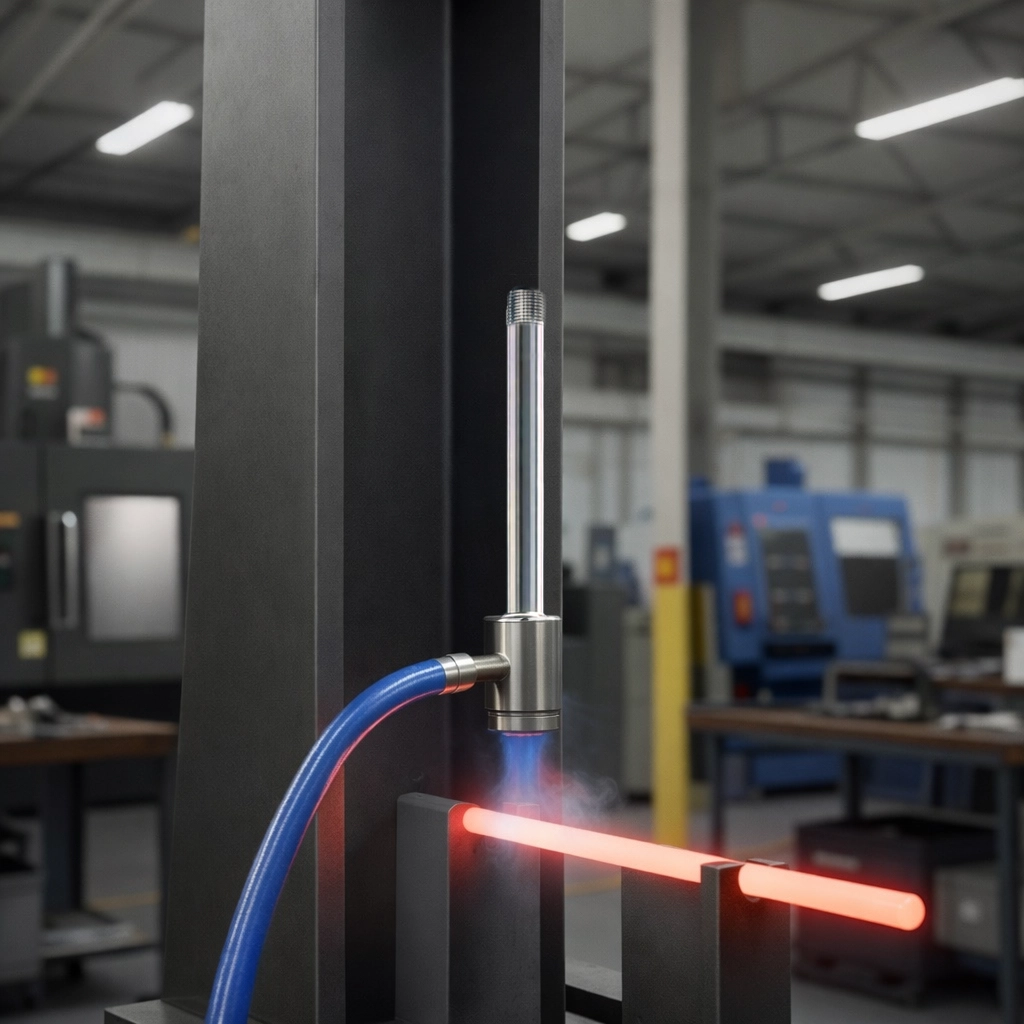
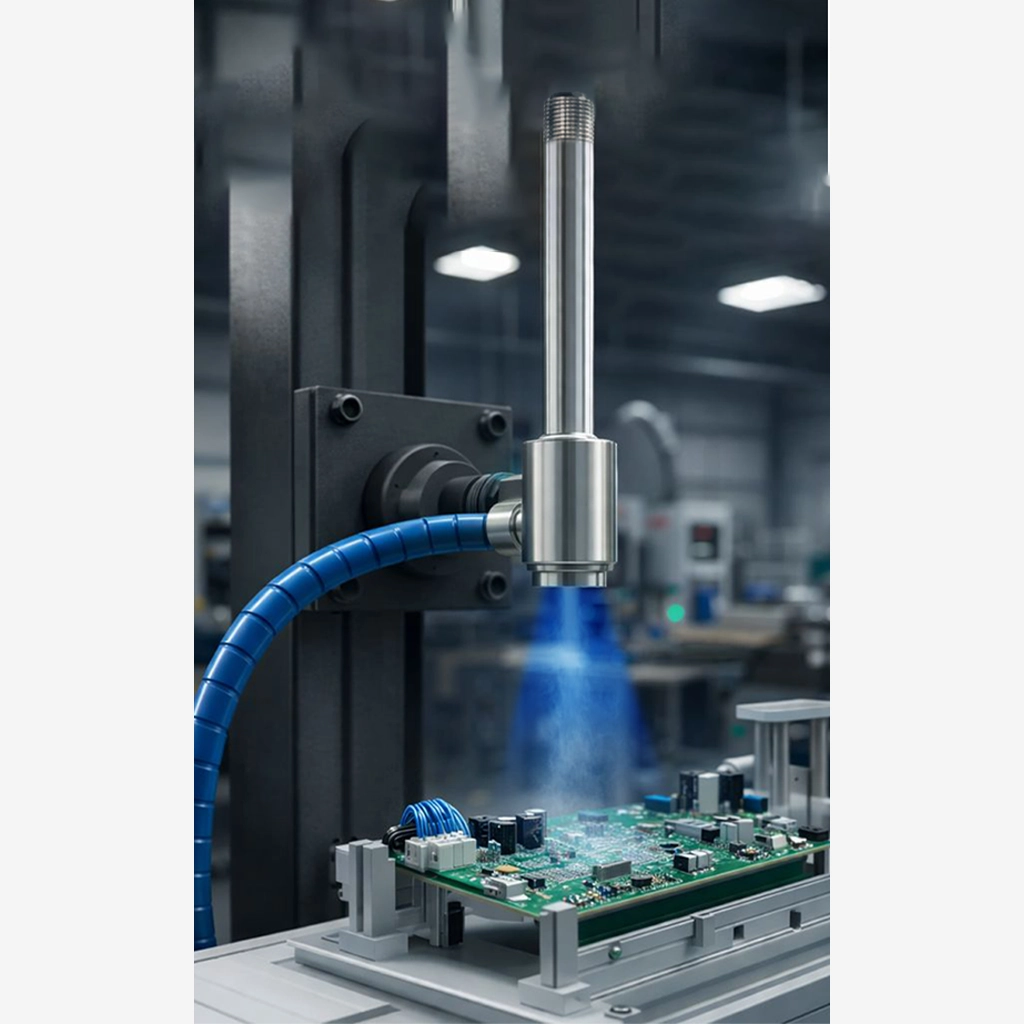
A vortex tube is an efficient, low-cost, and fast-acting solution for many industrial spot-cooling and spot-heating applications. It operates solely on compressed air, contains no moving parts, and uses no hazardous refrigerants that could leak. Inside the tube, compressed air is spun at high speed, causing it to separate into hot and cold air streams. The hot air stream can reach temperatures up to 190°F (88°C), while the cold stream can drop to –56°F (–49°C).
Supreme Air Products™ vortex tubes are offered in aluminum or stainless-steel material with a variety of SCFM capacities ranging from 2 SCFM (57 SLPM) to 40 SCFM (1133 SLPM). The small vortex tube ranges from 2 SCFM (57 SLPM) to 8 SCFM (227 SLPM), while the medium vortex tube ranges from 10 SCFM (283 SLPM) to 40 SCFM (1133 SLPM). With our optional generators, these capacities can be changed quickly and easily with the simple turn of a nut. For example, a 10 SCFM (283 SLPM) vortex tube that is used for small cooling needs, can be changed to 40 SCFM (1133 SLPM) for maximum cooling needs in less than 30 seconds.
Our vortex tubes are also available in two series – Series B and Series C.
Compressed Air Connection
The vortex tube connects to an air supply through a standard male NPT thread.
Air Entry and Spin Chamber Formation
Compressed air enters the tube through the NPT inlet and is directed into the internal spin chamber by the vortex generator.
High-Speed Spinning and Air Separation
Inside the spin chamber, the air is accelerated to extremely high rotational speeds. This spinning action causes the air to separate into hot and cold fractions due to differences in energy and pressure.
Air Distribution Within the Chamber
The hotter, higher-energy air is forced toward the outer walls of the chamber.
The colder, lower-energy air remains concentrated in the center.
Hot and Cold Air Discharge
The two air streams exit through opposite ends of the vortex tube—hot air from the hot end, and cold air from the cold end.
Temperature and Flow Adjustment
A temperature adjustment screw located at the hot end allows users to control the ratio of hot to cold air output:
Turning the screw counterclockwise opens the hot end, releasing more hot air. This reduces the volume of cold air and lowers the cold-end temperature.
Turning the screw clockwise restricts the hot end, releasing more cold air. This increases the volume of cold air but raises the cold-end temperature slightly.
.
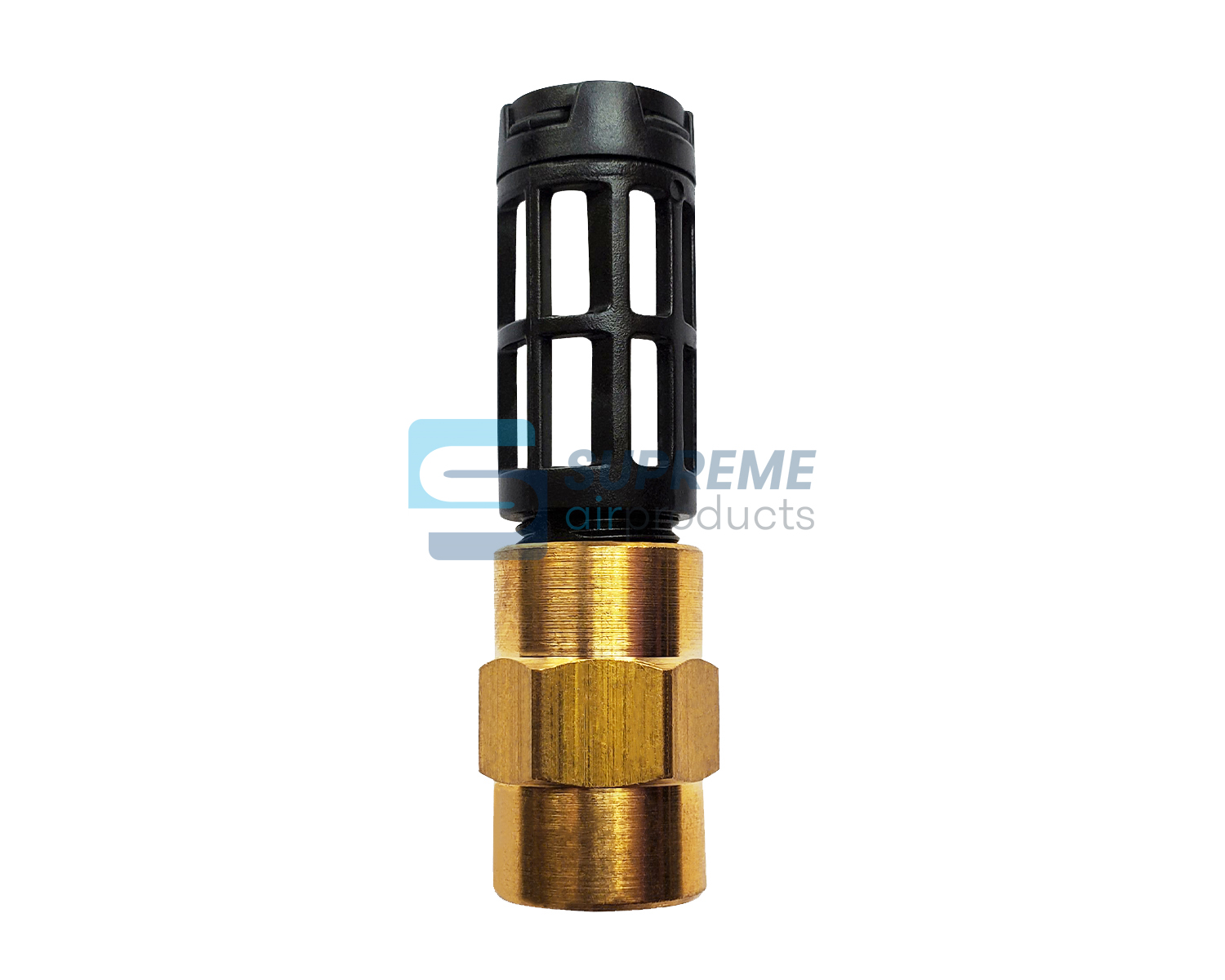
Supreme Air Products™ vortex tubes operate at different noise levels depending on the SCFM capacity. For example, the 15 SCFM (425 SLPM) capacity vortex tube operates at approximately 70 DB. To reduce noise levels, we offer optional cold end mufflers, which can reduce noise by up to 11 DB, and hot end mufflers, which can further reduce noise by an additional 4 DB.

Cold End Muffler
Hot End Muffler
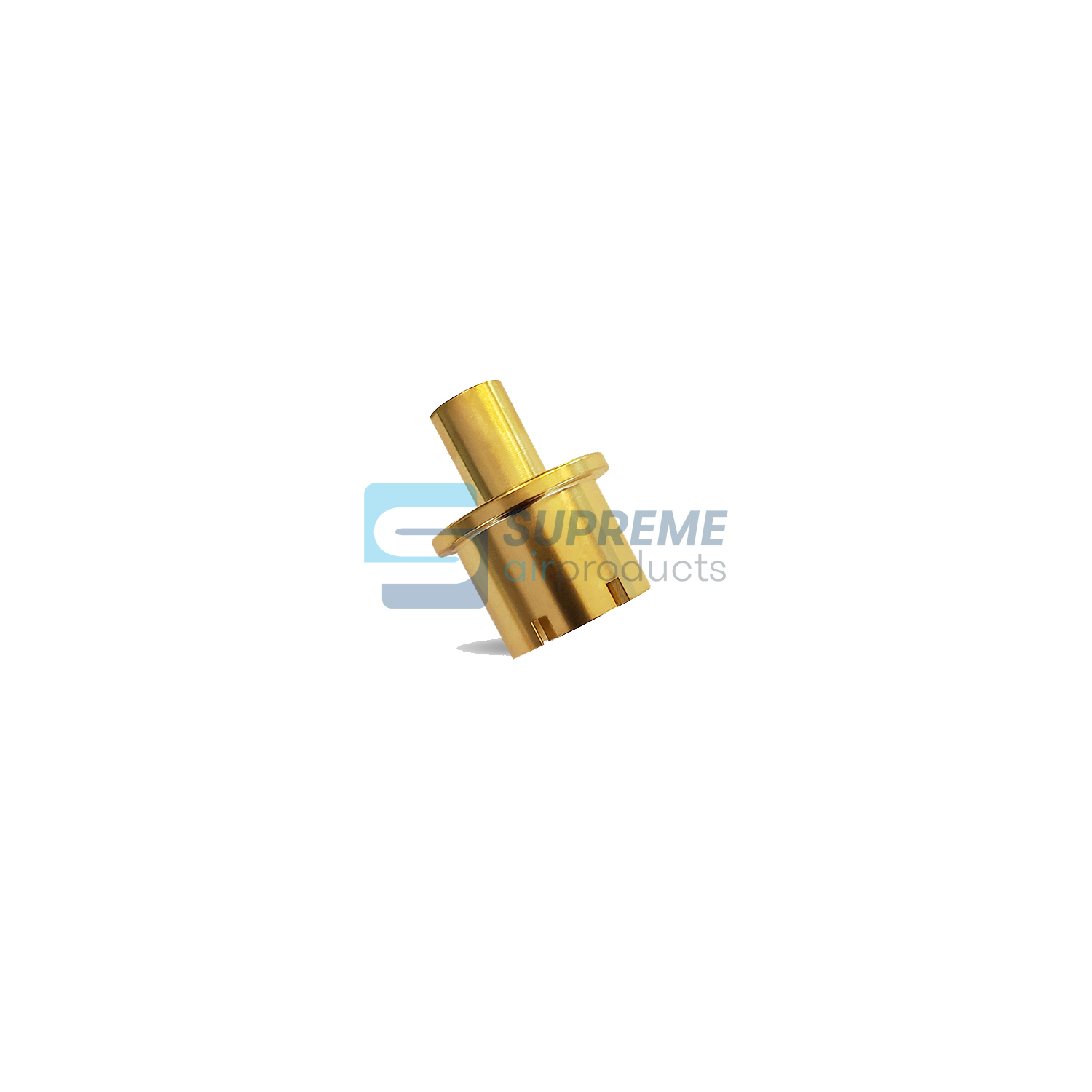
Single Extra Generator Option
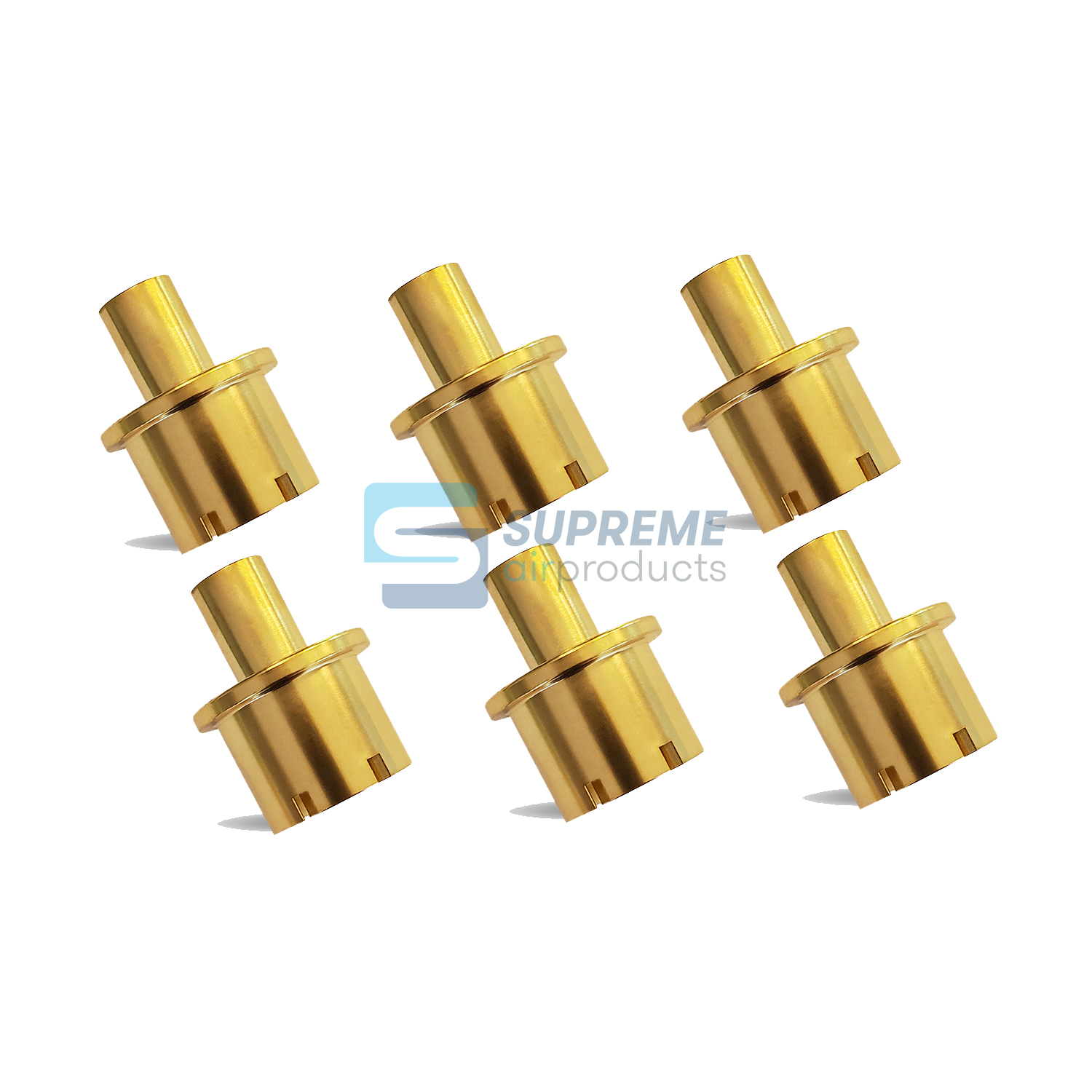
Full Generator Kit with all Capacities
Supreme Air Products™ goes above and beyond to ensure that installation of our products is simple and easy. Please visit our “Accessories” section to view optional accessories and refer to some examples of recommended setups below.
Which Vortex Tube will best suit my needs?
We offer two different Vortex Tube sizes: small and medium. Our Vortex Tubes are available in both aluminum and stainless steel construction. Stainless steel provides resistance against wear and tear, corrosion and oxidation, which ensures that a Vortex Tube from Supreme Air Products™ will provide years of reliable, maintenance-free operation. Aluminum Vortex Tubes are more affordable and 100% non-magnetic, which may be required in special applications. Please note that aluminum Vortex Tubes are only offered in sizes ranging from 10 SCFM (283 SLPM) to 40 SCFM (1133 SLMP).
B Series Vortex Tube Specifications
Our B Series Vortex Tubes are ideal for most common industrial applications such as: spot cooling, tool cooling, parts cooling and heating. B Series Vortex Tubes optimize airflow and temperature drop to produce maximum BTU’s of cooling capacity.
| Size | Model No. | Air Consumption | BTU/Hr. @ 100 PSIG | Kcal / Hr. @ 6.9 |
|---|---|---|---|---|
|
Small |
VT02B |
2 SCFM (57 SLPM) |
145 BTU/Hr. |
37 |
|
Small |
VT04B |
4 SCFM (113 SLPM) |
275 BTU/Hr. |
69 |
|
Small |
VT08B |
8 SCFM (227 SLPM) |
560 BTU/Hr. |
141 |
|
Medium |
VT10B |
10 SCFM (283 SLPM) |
700 BTU/Hr. |
176 |
|
Medium |
VT15B |
15 SCFM (425 SLPM) |
1100 BTU/Hr. |
277 |
|
Medium |
VT25B |
25 SCFM (708 SLPM) |
1800 BTU/Hr. |
454 |
|
Medium |
VT30B |
30 SCFM (850 SLPM) |
2060 BTU/Hr. |
519 |
|
Medium |
VT40B |
40 SCFM (1133 SLPM) |
2800 BTU/Hr. |
706 |
The C Series Vortex Tubes are used in special applications that require extreme cold temperatures such as circuit board testing and lab sample cooling. These Vortex Tubes provide the lowest cold air temperatures, but at reduced airflow (when less than 50% cold fraction is used). C Series Vortex Tubes should only be used when desired temperatures are below 0°F (-18°C).
Cooling capacity (BTU/hr) and (Kcal/Hr) is omitted for the C Series as these models are precision-engineered for maximum temperature reduction at low cold fractions rather than high-volume heat removal.
| Size | Model No. | Air Consumption | BTU/Hr. @ 100 PSIG | Kcal/Hr. @ 6.9 BAR |
|---|---|---|---|---|
|
Small |
VT02C |
2 SCFM (57 SLPM) |
– |
– |
|
Small |
VT04C |
4 SCFM (113 SLPM) |
– |
– |
|
Small |
VT08C |
8 SCFM (227 SLPM) |
– |
– |
|
Medium |
VT10C |
10 SCFM (283 SLPM) |
– |
– |
|
Medium |
VT15C |
15 SCFM (425 SLPM) |
– |
– |
|
Medium |
VT25C |
25 SCFM (708 SLPM) |
– |
– |
|
Medium |
VT30C |
30 SCFM (850 SLPM) |
– |
– |
|
Medium |
VT40C |
40 SCFM (1133 SLPM) |
– |
– |
Inlet Air Temperature
When the inlet air temperature is 76°F (24°C), our B Series Vortex Tube will reduce the temperature by approximately 76°F (42°C) on the cold end, depending on the percentage of the cold fraction.
Back Pressure
Low back pressure up to 2 PSIG (0.1 BAR) will not affect the performance of the Supreme Air Products™ Vortex Tube. Any pressure above 2 PSIG will affect the Vortex Tube performance negatively. As back pressure increases, the performance of the Vortex Tube decreases.
Filtration and Freezing
It is very important to maintain a clean and liquid-free air supply line. Supreme Air Products™ 5 micron Auto Drain Filters are ideal for compressed air lines because they remove dirt particles and water. If water enters a Vortex Tube, it will freeze and stop performing. When freezing occurs, all air flow to the vortex tube must be stopped to allow for thawing. Once it has thawed, the vortex tube can be operated normally again.
Noise and Muffling
Both small and medium Vortex Tubes can be quite noisy if un-ducted. Supreme Air Products™ offers mufflers for both cold and hot air discharge. Typically, unmuffled Vortex Tubes produce 70 dB of sound. Mufflers can reduce the noise level by approximately 15 dB when used at both ends.
| PSIG | Cold Fraction | ||||||||
| 10% | 20% | 30% | 40% | 50% | 60% | 70% | 80% | 90% | |
| 20 | 63F | 35C | 62F | 34C | 60F | 33C | 56F | 31C | 51F | 28C | 44F | 24C | 36F | 20C | 28F | 15C | 17F | 9C |
| 7F | 4C | 15F | 8C | 25F | 14C | 36F | 20C | 50F | 28C | 64F | 36C | 83F | 46C | 107F | 59C | 148F | 82C | |
| 40 | 91F | 51C | 88F | 49C | 85F | 47C | 80F | 44C | 73F | 41C | 63F | 35C | 52F | 28C | 38F | 21C | 26F | 14C |
| 9F | 5C | 21F | 11C | 35F | 19C | 52F | 29C | 71F | 39C | 92F | 51C | 117F | 65C | 147F | 82C | 220F | 122C | |
| 60 | 107F | 59C | 104F | 58C | 100F | 56C | 93F | 52C | 84F | 47C | 73F | 41C | 60F | 33C | 45F | 25C | 29F | 16C |
| 10F | 6C | 24F | 13C | 40F | 22C | 59F | 33C | 80F | 44C | 104F | 58C | 132F | 73C | 168F | 93C | 236F | 131C | |
| 80 | 119F | 66C | 115F | 64C | 110F | 61C | 102F | 57C | 92F | 51C | 80F | 44C | 66F | 36C | 49F | 27C | 31F | 17C |
| 11F | 7C | 25F | 14C | 43F | 24C | 63F | 35C | 86F | 48C | 113F | 63C | 143F | 79C | 181F | 101C | 249F | 138C | |
| 100 | 127F | 71C | 123F | 68C | 118F | 66C | 110F | 61C | 99F | 55C | 86F | 48C | 71F | 39C | 53F | 29C | 33F | 18C |
| 12F | 8C | 26F | 14C | 45F | 25C | 67F | 37C | 91F | 51C | 119F | 66C | 151F | 84C | 192F | 107C | 252F | 140C | |
| 120 | 133F | 74C | 129F | 72C | 124F | 69C | 116F | 64C | 104F | 58C | 91F | 50C | 74F | 41C | 55F | 31C | 34F | 19C |
| 13F | 8C | 27F | 14C | 46F | 26C | 69F | 38C | 94F | 52C | 123F | 68C | 156F | 87C | 195F | 108C | 257F | 142C | |
| The percentage of cold air produced versus total filtered compressed air consumed by vortex tube. |
| Pounds per Square Inch Gauge. |
| Drop in temperature. |
| Rise in temperature. |
Cold fraction is the “percentage of airflow” at the cold end. A 60% cold fraction means 60% of airflow is discharged at the cold end and 40% at the hot end.
The table above represents the B Series medium sized Vortex Tube with a 15 SCFM capacity. Performance can vary significantly at higher flow capacities. With that said, in most applications it is usually not imperative to achieve the lowest temperatures at the expense of cold airflow, therefore Vortex Tubes are pre-set to maintain an ideal balance between cold temperature and airflow.
Back-pressure on the cold-end exhaust will negatively affect the performance of the Vortex Tube. As a general guideline, approximately 5 PSIG of back-pressure can change performance by about 5°F.
Low back-pressure levels of up to 2 PSIG typically do not have a noticeable impact on performance.
For optimal operation, we recommend minimizing or eliminating back-pressure on the cold exhaust whenever possible.
Compressed air enters the Vortex Tube and spins at speeds of up to 1,000,000 RPM, moving toward the hot end of the tube. A small portion of this hot air is released through a control valve at the hot end, while the remaining air is forced back toward the opposite end, exiting as cold air.
This separation of hot and cold air occurs without any moving parts, making the Vortex Tube a simple and reliable device for spot cooling or other applications.
The Vortex Tube, a product of Supreme Air Products™ Corp., uses compressed air as its only power source to produce cold air at one end and hot air at the other—completely without any moving parts.
The cold air is commonly used for spot cooling and refrigeration applications, while the hot air can be used for spot heating. Note that the hot air temperatures are moderate and not intended for high-heat applications.
The Vortex Tube was invented in 1933 by French physicist Georges J. Ranque. Later, in 1947, German physicist Rudolf Hilsch improved the design and published a widely cited paper on the device, which he called the Wirbelrohr (meaning “whirl pipe”).
Over the years, it has been known by various names, including the “Hilsch Tube,” “Ranque Vortex Tube,” “Maxwell’s Demon,” and “Ranque-Hilsch Tube.” Today, it remains a simple, reliable, and cost-effective solution for spot cooling applications in industrial settings.
Supreme Air Products™ offers Small and Medium Vortex Tubes with a wide range of cooling capacities. Our Vortex Tube Generator Kits allow you to experiment with different temperatures and airflow rates to find the optimal setup.
For best results, we recommend consulting a Supreme Air Products™ Application Engineer, who can help you select the Vortex Tube best suited for your specific application.
No. The Vortex Tube has no moving parts, so it does not wear out. Occasional cleaning may be required if contaminants enter the air supply.
The Vortex Tube is built for durability, with a Type 303 stainless steel body, brass generators, and a brass control valve.
The Vortex Tube is ideal for spot cooling applications. It can be used to cool molds, machine operations, hot parts, electronics, and other localized areas.
The hot air output can be used for applications such as heating adhesives, shrink wrapping, or drying parts.
While a Vortex Tube can be used, there are clear advantages to using a Supreme Air Products™ Cabinet Panel Cooler for this application:
Pressure relief: Cabinet Panel Coolers include a built-in pressure release valve, allowing warm air to escape from the enclosure.
Optimized performance: Panel Coolers are factory-tuned for maximum refrigeration. Vortex Tubes are adjustable, which can lead to improper operation if misadjusted.
Noise reduction: Cabinet Panel Coolers are engineered to operate with significantly lower noise levels compared to a single Vortex Tube.
No. The Air Amplifier and Air Knife would both restrict the air flow of the Vortex Tube to the point where back-pressure would limit the cooling capacity of the Vortex Tube. The cold end of the Vortex Tube should not be subjected to a backpressure in excess of 5 PSIG.
The Vortex Tube Performance Charts give approximate temperature drops (and rises) from inlet air temperature produced by a SUPREME AIR PRODUCTS Vortex Tube set at each various cold fraction. Assuming there is no fluctuation of inlet pressure or temperature, the Vortex Tube will reliably maintain temperature within ±1°F.
There are two ways to find out what Cold Fraction you are currently using on your SUPREME AIR PRODUCTS Vortex Tube.
(1) By using the Performance Data chart found under our Specifications tab on this page. You can measure the temperature of cold air exhausting and compare it to the chart. It’s important to note that the air temperature should be taken immediately out of the Vortex Tube as the airflow will quickly warm as it mixes with ambient air.
(2) An air flow meter can also be used to measure the volume of air both coming out of the unit and going into Vortex Tube. Then use these values and compare the cold or hot flow of the unit. By comparing the cold or hot flow rate to the total will give you accurate hot or cold fraction.
The Vortex Tube is rated in BTU/Hr. based on inlet temperatures of 68F and pressure of 100 PSIG. Any change of temperature or pressure will affect the rating of the Vortex Tube. Please contact a Supreme Air Products™ Application Engineer to determine the effect of pressure and/or temperate changes on the Vortex Tube’s rating.The Vortex Tube is rated in BTU/hr based on an inlet air temperature of 68°F and a supply pressure of 100 PSIG. Changes in temperature or pressure will affect the unit’s performance and rating.
For assistance in determining how variations in pressure or temperature impact your Vortex Tube’s performance, please contact a Supreme Air Products™ Application Engineer at 647-876-6358.
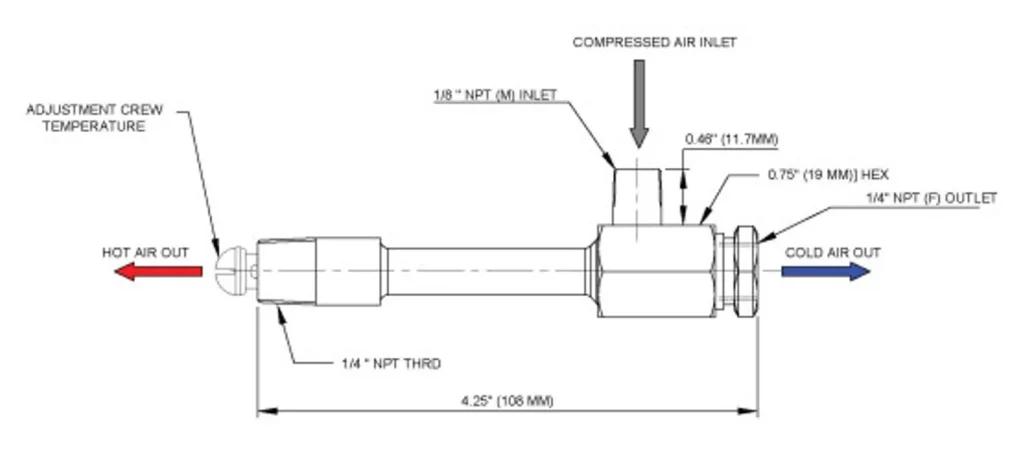
Small Vortex Tube Capacity 2 - 8 CFM
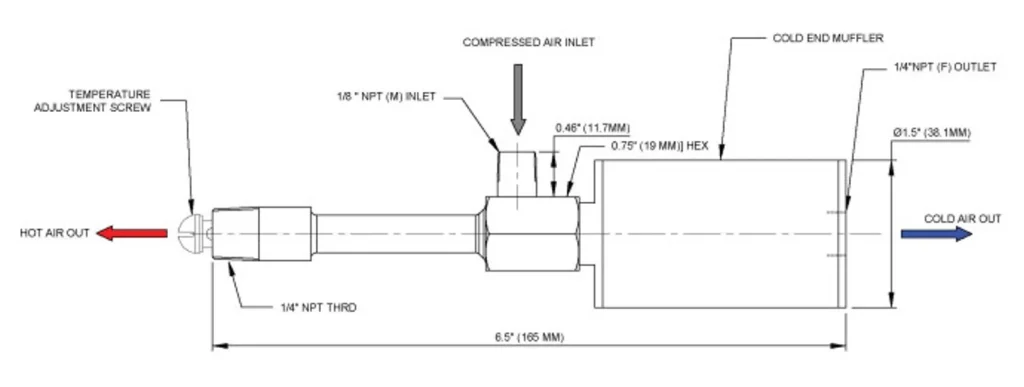
Small Vortex Tube (2 - 8 CFM) With Cold End Muffler
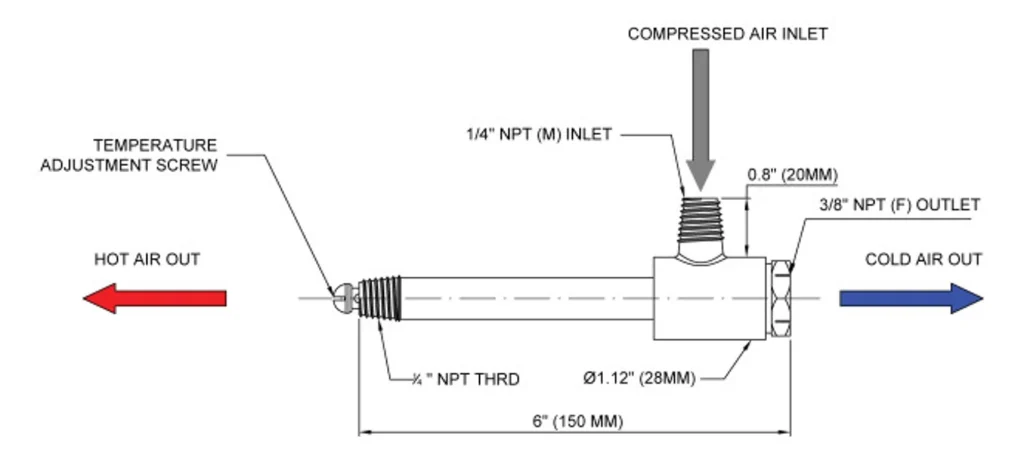
Medium Vortex Tube Capacity 10 - 40 CFM
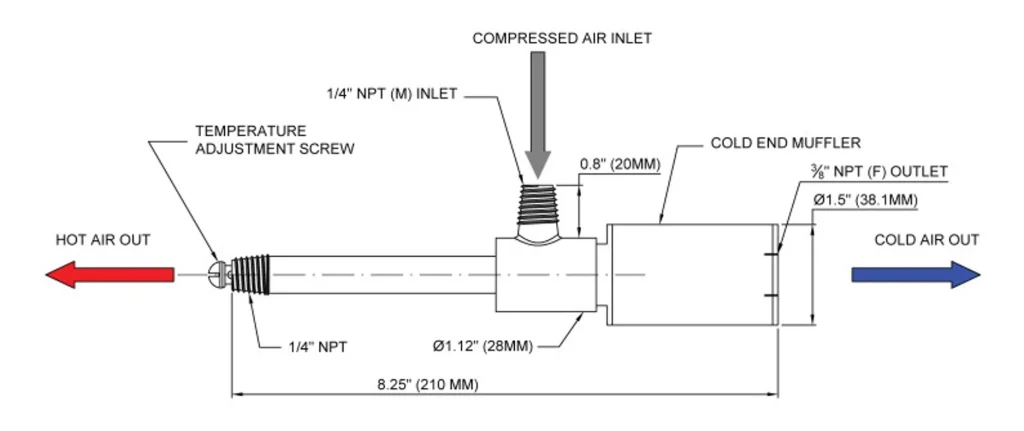
Medium Vortex Tube (10 - 40 CFM) With Cold End Muffler